
Fashion
Miraggio launches Bag Charms Pioneering a New Era of Personalized Accessories in India, available on Zepto


With the expansion into bag charms category, Miraggio aims to elevate everyday accessories making accessorizing more accessible than ever
New Delhi, March 2025: Miraggio, the renowned handbag brand known for its innovation, sophistication, and versatility, announces its foray into the handbag accessories with the launch of Bag Charms collection. As bag personalization emerges as a major fashion trend, this collection offers a stylish and effortless way for consumers to elevate their everyday accessories.


With statement bag charms becoming a must-have, Miraggio’s latest category expansion empowers fashion enthusiasts to express their individuality and refresh their handbags with a touch of playful elegance. This launch marks a new chapter in personalized accessorizing, blending modern trends with Miraggio’s signature aesthetic.


In a first for the industry, Miraggio’s charms will also be available on Zepto, making it the pioneering brand to introduce bag charms on a quick commerce platform, ensuring unparalleled convenience and accessibility for fashion enthusiasts seeking unique, expressive accents for their handbag and offering a seamless, on-the-go styling solution.


Miraggio first introduced bag charms as part of its most awaited Denice 2.0 launch, offering a limited-edition charm box to amplify the collection. The response was overwhelming—fashion enthusiasts went crazy over it, with many willing to purchase it at full price despite it being a complimentary offering for a limited time. This enthusiastic demand provided key market insights, reinforcing the growing trend of handbag personalization and inspiring Miraggio to officially launch its Bag Charms collection.
Designed as tools for self-expression, these charms empower customers to curate a look that is uniquely theirs. Crafted with a keen focus on contemporary aesthetics and premium materials, Miraggio ensures that each piece strikes the perfect balance between style and durability. Packaged in beautifully designed boxes, these bag charms also make for the perfect last-minute gift—stylish, thoughtful, and effortlessly elegant. Whether as a personal indulgence or a charming present, they add a touch of personality to any handbag, making them a must-have accessory for fashion lovers.
In a short span, Miraggio has already sold 1,500 bag charms, demonstrating strong initial market traction.The Indian fashion accessories market is experiencing robust growth, with the bag charm segment poised for significant expansion, fueled by increasing demand for personalized embellishments. Current market estimates place the segment between ₹50-100 crores (approximately $6-12 million USD), with projections indicating a 15-20% annual growth rate.
Speaking on the occasion, Mohit Jain, Founder & CEO, Miraggio, said “At Miraggio, we believe accessories are more than just adornments—they are extensions of personal identity, a canvas for self-expression. The overwhelmingly positive response to our bag charms reaffirms our vision of making fashion more personal, stylish, and accessible. As the first brand to offer bag charms on Zepto, we are redefining convenience, bringing statement accessories to consumers faster than ever before.”
Miraggio’s bag charm collection embraces the latest trends, featuring bows, hearts, flowers, and cords—design elements that resonate with evolving fashion preferences. Best-selling designs, including the Cupid Charm Set, Daisy Charm, Puffy Pup, and Blushin’ Bow Charm, have already garnered consumer interest and popularity.
Committed to continuous innovation, Miraggio plans quarterly collection releases while also introducing limited-edition drops throughout the year, ensuring a constant stream of fresh, on-trend designs. With a pulse on global fashion trends and a focus on personalization, Miraggio continues to push the boundaries of self-expression through accessories.
The bag charm collection is available for purchase on Zepto and at Miraggio’s website: https://miraggiolife.com/











CROISETTE CHRONICLES — PART II
“Sun, Silk & Studied Chaos”
If the first week of Cannes 2026 whispered, the second week grabbed you by the collar.
A blush-pink strapless column gown arrived on the Croisette with the kind of quiet ferocity only a seasoned red carpet can absorb. Pearl-scattered at the bust, its satin surface caught every camera flash. It was paired with a voluminous silver-grey cocoon coat draped off both shoulders — not worn, deployed. Chandelier diamonds framed the ears, stacked rings adorned both hands, and sleekly pulled-back hair revealed a razor-sharp jawline. This was old Hollywood reconstructed by someone who found the original too polite.
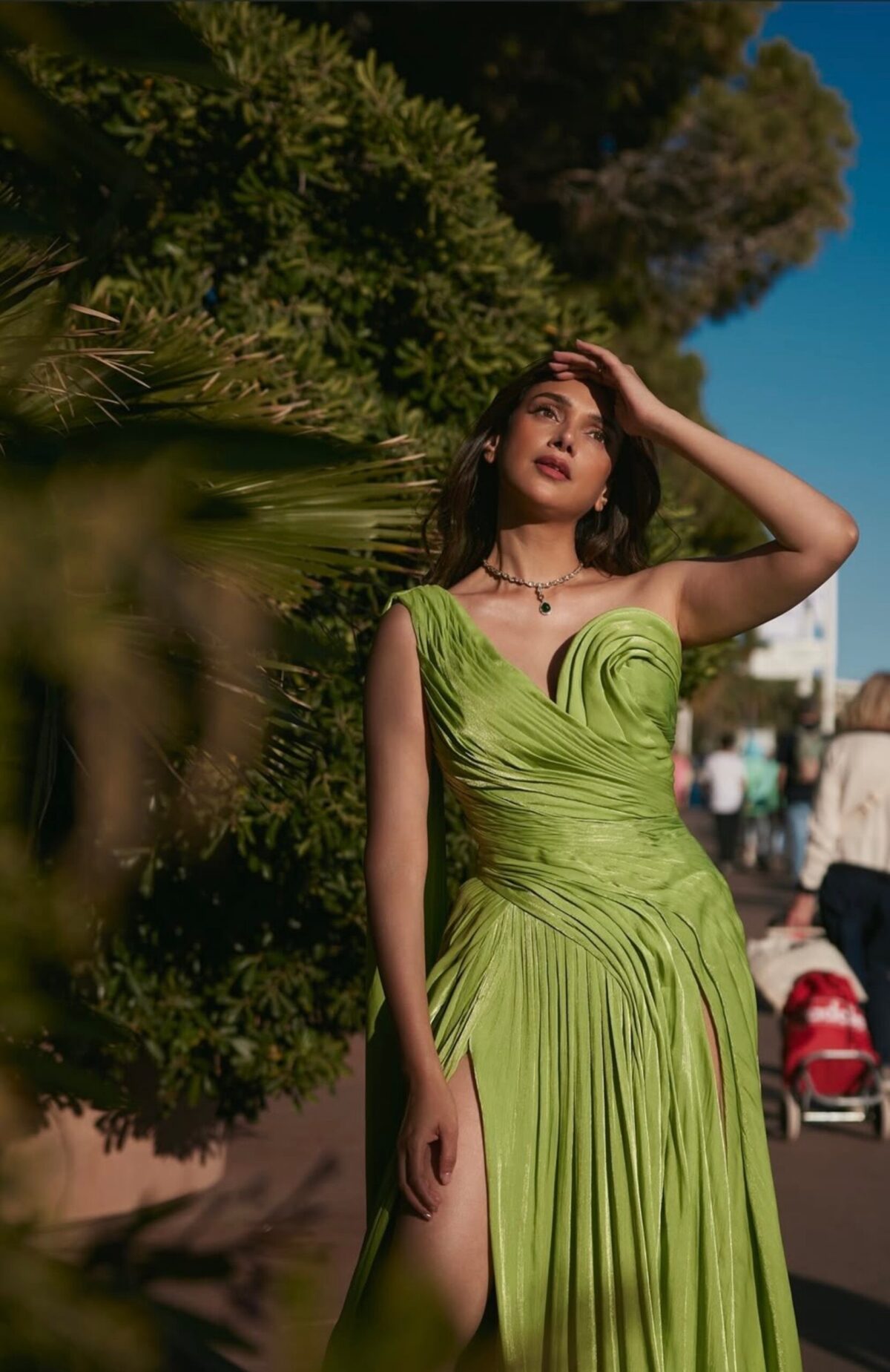
Then came the moment that stopped the Croisette mid-scroll: a chartreuse pleated one-shoulder gown, its fabric engineered into deep diagonal ridges sweeping from a sculpted shoulder down to a dramatic thigh-high slit. Photographed against palm trees and Mediterranean light, it looked less like an outfit and more like a natural phenomenon — moss-coloured, elemental, inevitable. A single emerald pendant rested at the throat. Loose waves, barely tamed, completed the look. The overall effect? A woman who dressed for the landscape, not the photographers — and somehow captivated both.
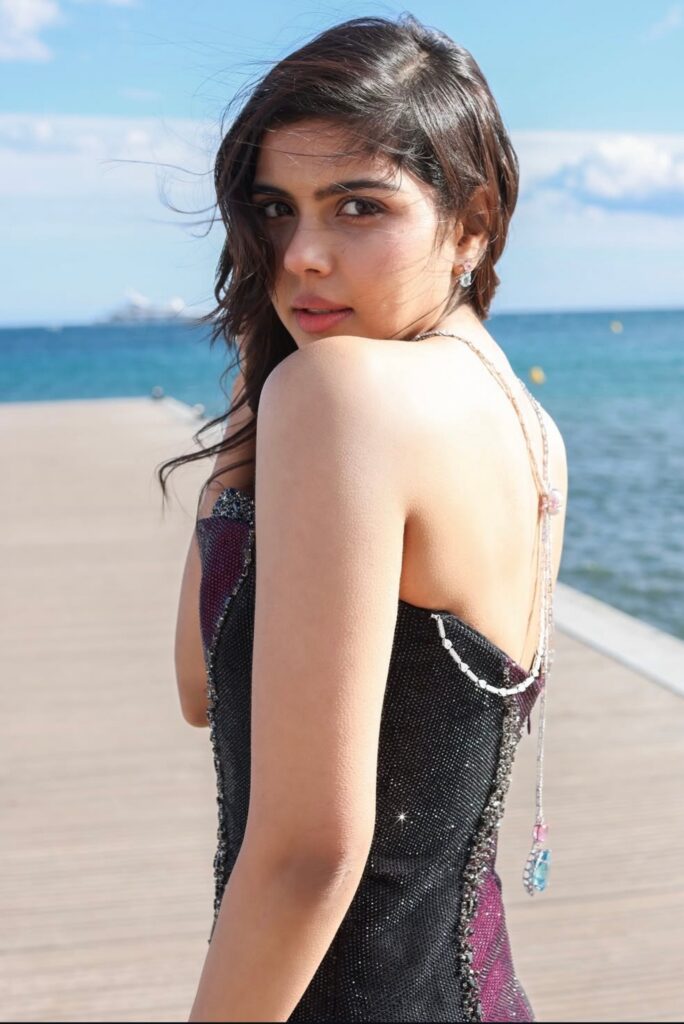
Beside the sea, another story unfolded. A dark sequinned gown — midnight black fading into deep magenta — was worn against the backdrop of open water. Hair loosened by the wind, a glance thrown back over one bare shoulder. Delicate crystal chains descended the open back like jewellery transformed into architecture. No carpet, no crowd. Just Riviera light and the confidence to command it entirely.

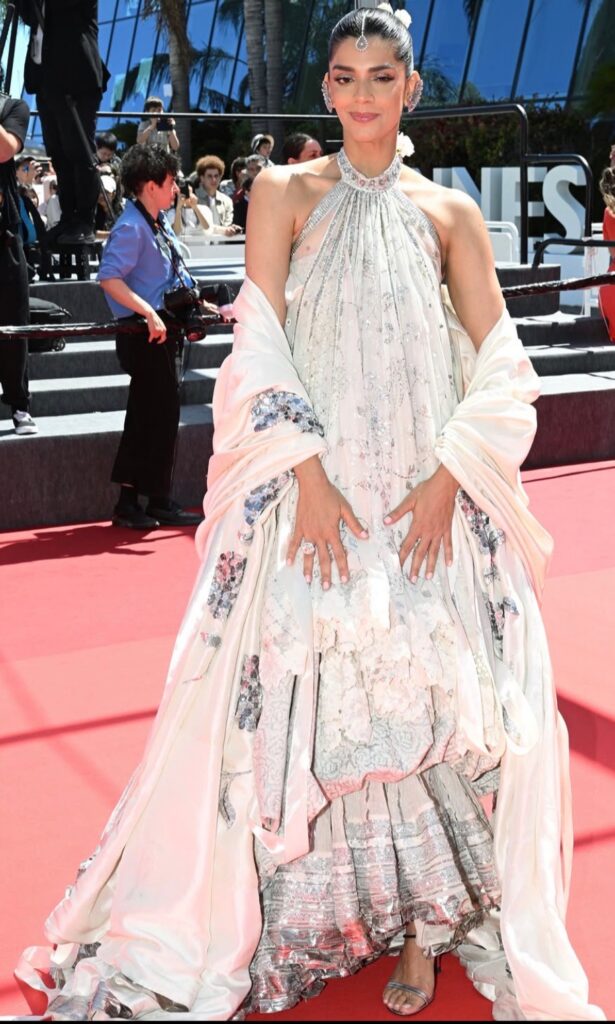
Then came the cultural statement that deserved its own paragraph: a halter-neck anarkali of extraordinary intricacy. Silver and blush floral embroidery spread across ivory silk, while a heavily diamond-encrusted halter neckline functioned as both collar and jewel. A maang tikka and oversized jhumkas completed a look worthy of museum display. A blush dupatta trailed behind with quiet drama. This was Indian couture presented not as a translation for a Western audience, but entirely on its own terms — unapologetic, uncompromising, and self-assured.
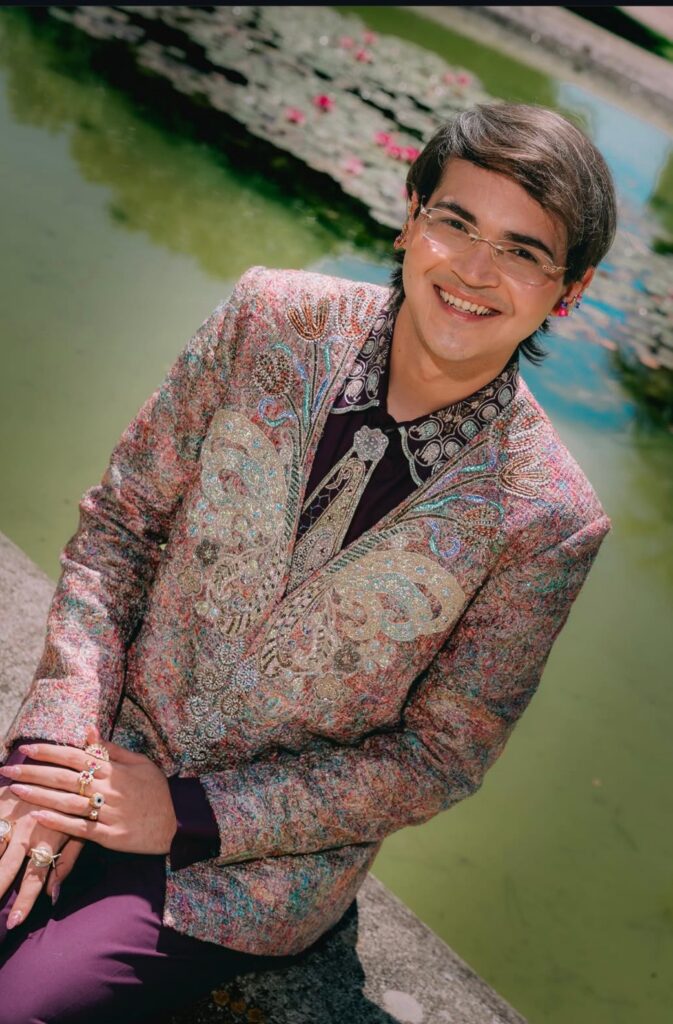
Finally, there was the fashion commentator who became the story. A multicoloured embroidered bandhgala blazer — alive with iridescent threadwork in mauve, teal, and gold — was paired with plum trousers and a galaxy of statement rings. Frameless glasses added restraint to the visual richness, while the smile carried a different message altogether: I dressed for myself first. At Cannes, where everyone performs for someone, that may be the most radical statement of all.
“The Riviera didn’t dress them. They dressed the Riviera.”
Events
Fashion Designer Amit GT and Le Marquise Jewellery by Jasmine Gulati Jain and Sambhav Jain Showcase Excellence Under the Golden Lumière Awards at the 79th Festival de Cannes 2026 Show Directed by Liza Varma
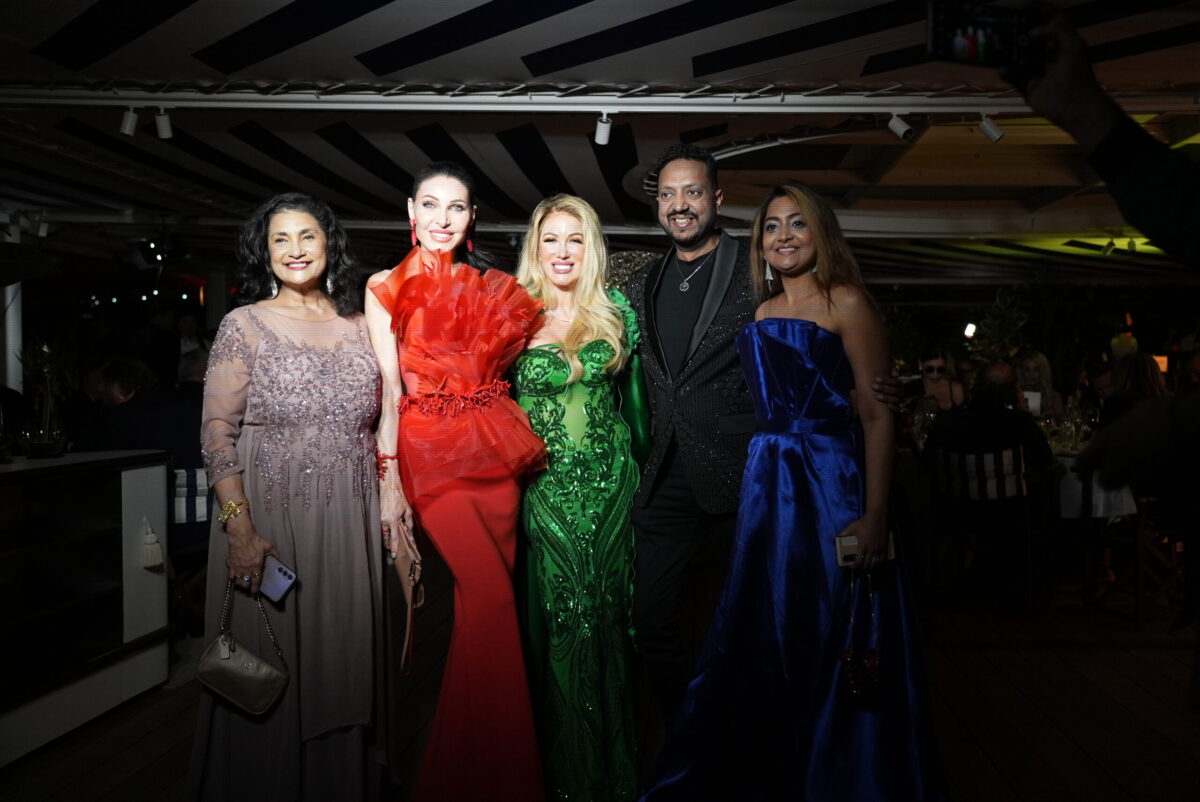
As part of India’s multi-platform presence at the 79th Festival de Cannes 2026, internationally renowned Show Director Liza Varma from India led a delegation of Indian designers and jewellery labels at the Fashion TV Presentation held on 18th May 2026 at the Majestic Hotel, Cannes, at 9:30 PM (CEST).
The showcase featured celebrated Indian designer Amit GT along with Le Marquise Jewellery by Jasmine Gulati Jain and Sambhav Jain, presenting a curated display of fashion and jewellery that reflected contemporary Indian design sensibilities on an international platform. Amit GT’s showcase was presented under the prestigious Golden Lumière Awards Cannes 2026, hosted at the Majestic Hotel Beach, Cannes.
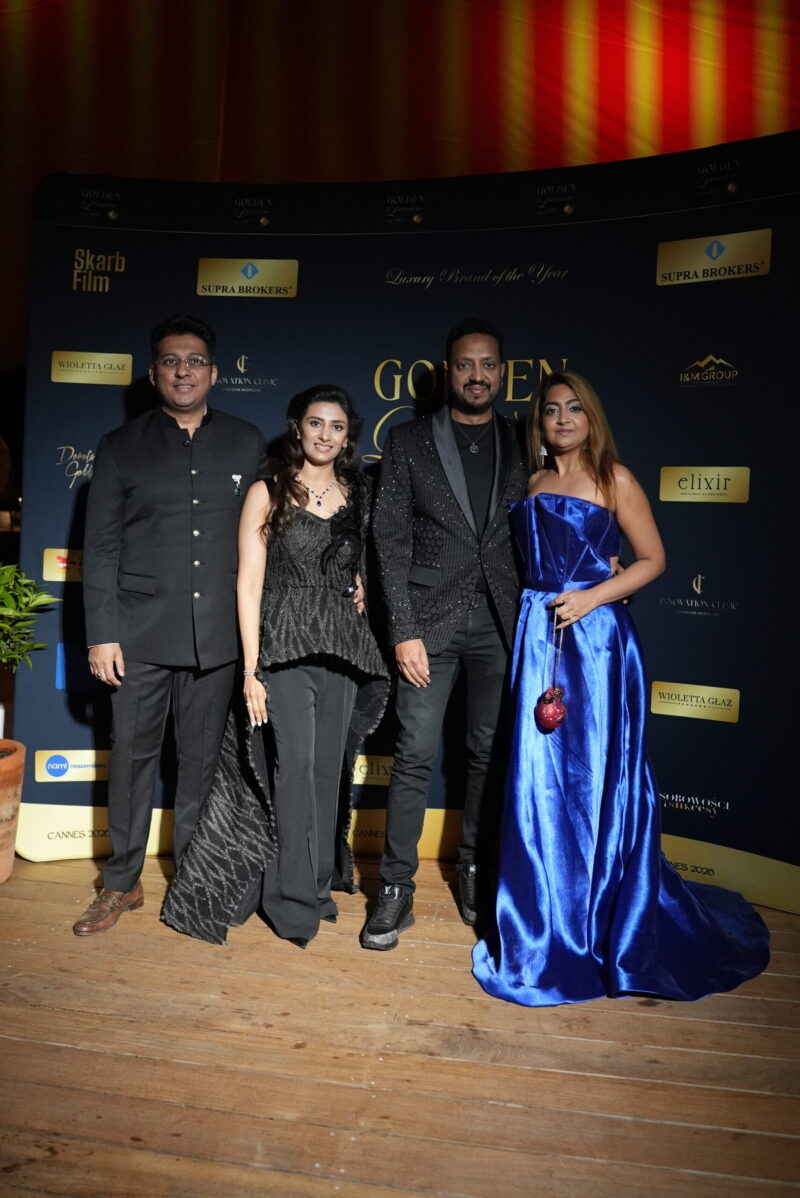
The Golden Lumière Awards show is hosted at the Majestic Hotel Beach, Cannes2026, where cinema meets luxury, celebrating outstanding personalities from international cinema along with visionary business leaders supporting art, culture, cinema, and the future generation of creators. The grand evening was attended by international personality Farhana Bodi and actress Urvashi Rautela, while actress Pooja Batra. The event was produced by Anna Neneman from ENW Showroom.

Speaking about the showcase, Liza Varma said, “My focus is to create opportunities for Indian designers and talent to present their work in international environments. Cannes provides an important global platform to showcase the strength of Indian fashion, craftsmanship, and creative talent before an international audience.”
Held alongside the 79th edition of the Cannes Film Festival 2026, the presentation formed part of a larger initiative led by Liza Varma to create global visibility for Indian designers, jewellery labels, and creative talent through curated showcases and international collaborations at Cannes.

Baby Forest Maasoom Petika: A Thoughtful Ayurvedic Baby Care Gift for First Raksha Bandhan

Birla Cellulose’s Handloom Initiative Brings New Possibilities for Traditional Weaving

EAW Global Aqua Expo 2026 Inaugurated at Bharat Mandapam; Water Leaders Convene to Shape India’s Water Future






An Evening of Healing, Hope, and Humanity: The Healing Brush Unveiled at Delhi Golf Club

Meltdown Proof: How to Protect Your Skin from India’s Ultimate Summer

Baby Care Essentials Every Parent Needs This Summer

Star-Studded Premiere of Bharat Bhagya Vidhat

Beyond Silence: A Smarter Way to Meditate

Masters of the Universe Review: A Triumphant Return to Eternia

 Events7 years ago
Vandy Mehra & Dr. Sanjana Jon hosted a fashionable evening

 Celebrities2 years ago
VOGUE EYEWEAR UNVEILS ‘KEEP PLAYING’, AN EFFERVESCENT CAMPAIGN WITH BRAND AMBASSADOR
 Lifestyle2 years ago
Aza Fashions Launches Flagship Store in Dhan Mill, New Delhi

 Celebrities2 years ago
Sony AATH is premiering the 4th Gopal Bhar movie titled ‘Gopaler Buddhi

 Business9 years ago
Uber and Lyft are finally available in all of New York State

 Health & Beauty2 years ago
The Face Shop Unveils the Vitamin Lip Sleeping Mask: A Revolution in Lip Care

 Celebrities2 years ago
Appu gives meaningful message in country’s first 4K animated

 Lifestyle2 years ago
2025 Numerology Predictions by Tarot Reader Sangeeta Walia